


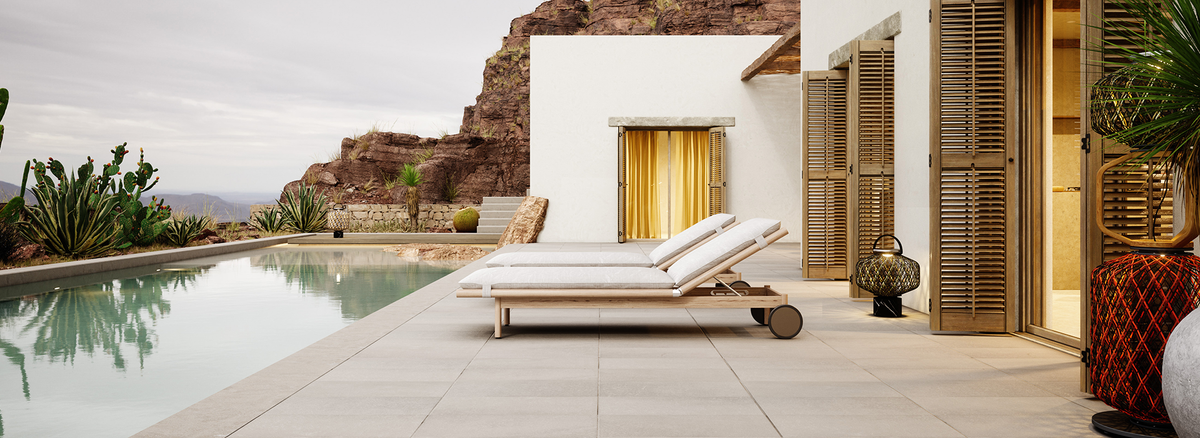
In the Gulf, outdoor furniture is tested by more than heat. UV exposure, humidity, airborne salt, sand, wind, irrigation and intensive hospitality use all influence what will age well—and what will not.

The expression “suitable for outdoor use” sounds reassuringly definitive. In practice, it is only the beginning of the specification.
A chair designed for a shaded European garden and a chair positioned beside a hotel pool in Dubai may both be described as outdoor furniture, yet they inhabit radically different conditions. The UAE combines severe solar exposure with heat, humidity, dust, occasional rain, irrigation, pool chemicals and—in coastal locations—salt-laden air. Hospitality projects add another layer: continuous movement, cleaning, food service, sunscreen, wet swimwear and high guest turnover.

The correct question is therefore not whether a piece can go outdoors. It is whether its entire construction is appropriate for a precise location, level of exposure and operating model.
Read the site before reading the catalogue
Climate specification begins with observation. A north-facing covered terrace may remain relatively protected, while a south- or west-facing pool deck can receive prolonged direct sun. A beachfront resort may have lower ambient dust than an inland site but much greater salt exposure. A rooftop can be clean and dry yet subject to strong winds and difficult access.
Divide the project into environmental zones. Record direct sunlight, shade, proximity to sea or pool, prevailing wind, irrigation, planting, ground surface and daily occupancy. This simple exercise is more useful than applying one generic “GCC specification” across an entire property.
UV exposure changes more than colour
Strong sunlight is often discussed as a fading issue, but UV exposure can affect the integrity of unsuitable plastics, coatings, fibres and stitching over time. It can also heat dark surfaces to uncomfortable temperatures.
For exposed locations, review how every visible and hidden component responds to sunlight: frame finish, woven fibre, rope, textile, thread, zips, elastic, glides and adhesives. A premium frame paired with weak stitching is still a weak product.
Colour selection matters too. Very dark metals and tabletops can become hot in direct sun; very pale fabrics may reveal staining more readily. The best choice balances thermal comfort, appearance and maintenance rather than following a palette in isolation.
Heat demands dimensional stability and sensible detailing
High temperatures amplify small construction weaknesses. Materials expand and contract. Poorly designed junctions can loosen. Trapped heat and moisture can affect cushions. Surface finishes may become uncomfortable to touch.
Look for outdoor furniture developed as a complete engineered system rather than an indoor design reproduced in nominally weather-resistant materials. Drainage points should be deliberate. Metal sections should be finished consistently, including less visible areas. Tabletops should allow for movement, and cushions should release moisture rather than hold it.
Humidity and salt require different thinking
Humidity alone does not create the same risk as salt. In coastal environments, salt settles on frames, fittings and textiles, where it attracts moisture and accelerates corrosion or staining if not removed. The closer the furniture is to breaking waves or sea spray, the more demanding the condition.
Powder-coated aluminium is widely used because it is light, versatile and corrosion-resistant when correctly prepared and finished. Stainless steel can also perform well, but the grade, surface finish, welding quality and maintenance regime matter. No metal should be treated as entirely maintenance-free in a marine environment.
Coastal furniture benefits from simple forms that can be rinsed and inspected. Highly intricate joints and inaccessible crevices may collect salt and sand. Removable components should be easy to detach without specialist tools.
Sand is both abrasive and operational
Fine airborne sand can dull finishes, enter moving mechanisms and settle into textile weaves. It is not usually dramatic; it is cumulative. Furniture that is difficult to clean will gradually look tired even when the underlying structure remains sound.
Choose finishes that tolerate regular gentle cleaning. Avoid unnecessary mechanical complexity in highly exposed zones. Consider how cushions will be stored during sandstorms or low-occupancy periods, and ensure covers can be removed without dismantling the entire product.
Wind stability must be designed, not improvised
Lightweight furniture is convenient for housekeeping but can be problematic on exposed rooftops and waterfront terraces. The answer is not simply to specify the heaviest item available. Weight, footprint, centre of gravity, aerodynamic form and storage strategy should be considered together.
Umbrellas deserve particular scrutiny. Base weight, anchoring, canopy size and wind-management procedures must be matched to the site. An umbrella that is safe in a sheltered courtyard may be inappropriate on an open terrace. Operators also need a clear threshold and procedure for closing or removing canopies.
Cushions are usually the first visible test
Outdoor cushions sit at the intersection of comfort and climate. They must feel generous enough for luxury hospitality while draining and drying efficiently. Review the complete cushion build-up: quick-drying or reticulated foam where appropriate, breathable construction, outdoor-rated textile, suitable thread, protected zips and a method for securing cushions in wind.
“Water-resistant” is not the same as “waterproof,” and waterproof is not always desirable. A fully sealed cover can trap heat or moisture if water enters through a seam or zip. The objective is controlled drainage and drying, supported by sensible storage and care.
Specify for cleaning reality
Hotels do not clean furniture as a laboratory would. They clean quickly, repeatedly and often under pressure. The selected materials should tolerate the property’s actual housekeeping routine, water quality and approved cleaning products.
Before procurement, ask the operator who will clean the furniture, how often and where cushions will be stored. Confirm whether covers are practical, whether loose cushions can be labelled by zone and whether replacement upholstery can be ordered later. A technically excellent fabric that requires an unrealistic care ritual is not an operationally excellent choice.
Judge performance as a system
The best furniture for the UAE is rarely defined by one heroic material. Performance comes from the relationship between frame, finish, hardware, textile, foam, construction and care.
A well-specified product should also be supported by reliable documentation: technical data, finish samples, maintenance instructions, warranty terms and access to spare parts. Brand reputation has value, but project-specific evidence is more useful. Ask where the product has been installed, under what conditions and how replacement components are managed in the region.
Design ambition does not need to be reduced
Climate-conscious specification is sometimes mistaken for conservative design. The opposite can be true. Once the performance criteria are clear, designers can choose more confidently among refined silhouettes, tactile materials and expressive colour.
The goal is not to make outdoor spaces look indestructible. It is to create rooms in the open air that retain their elegance because the technical decisions were made early, discreetly and well.
What is the best frame material for outdoor furniture in Dubai?
There is no single best material. Correctly finished aluminium, suitable stainless steel, quality teak and engineered synthetic fibres can all perform well. The right choice depends on exposure, weight requirements, maintenance and design intent.
Can outdoor cushions be left outside in the UAE?
Some outdoor cushions are designed to tolerate occasional moisture and strong sun, but performance improves when cushions are covered or stored during prolonged non-use, sandstorms and severe weather. Follow the manufacturer’s care guidance.
Is marine-grade furniture necessary everywhere in the UAE?
Not everywhere. It is most relevant in coastal and salt-exposed locations. Inland or protected terraces may allow a broader selection, provided the products remain appropriate for UV, heat, dust and operational use.
Draft article word count: approximately 1,209 words. Final CMS count may vary slightly.


