


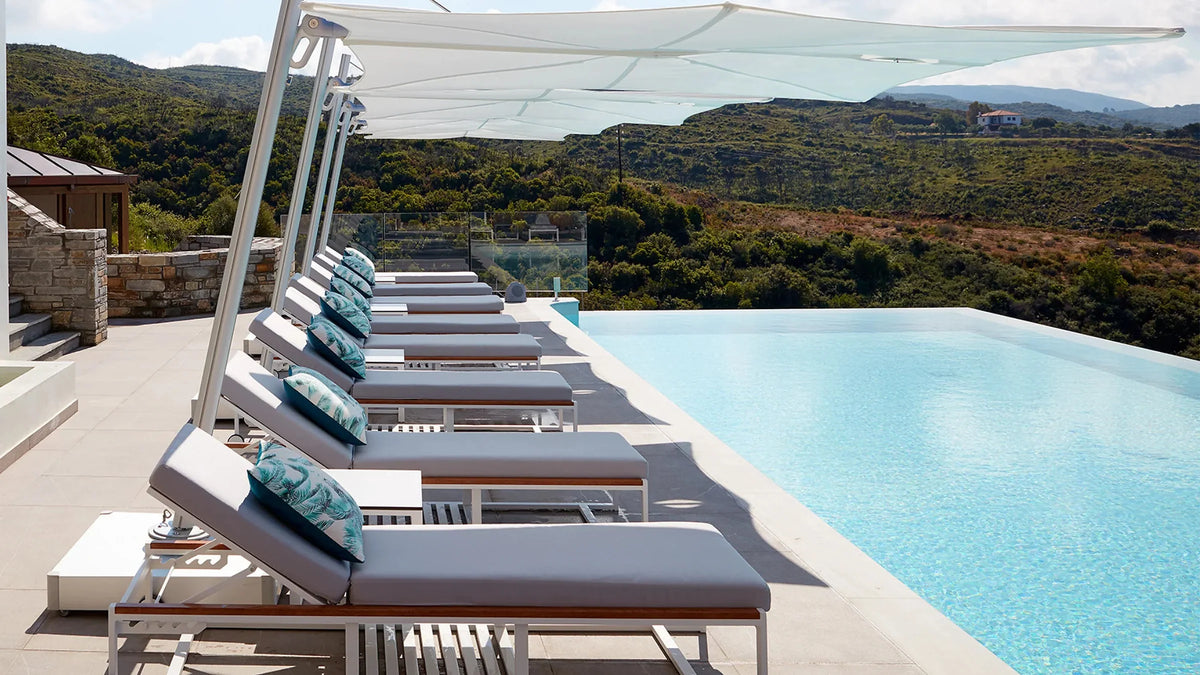
Quick answer: Measure the area the people actually occupy, not the table or lounger, then add 60 to 90 cm of canopy on every side. A six-seat dining table of about 2 x 1 m sits comfortably under a 4 x 3 m rectangular canopy. Choose a centre-pole parasol for dining and a cantilever for lounge and pool zones, and match the base to the manufacturer's chart for that canopy size.
Most parasols are bought to match the furniture: a 2-metre table, so a 2.5-metre parasol. It looks right in the catalogue. It works for about an hour a day.
The sun is rarely straight overhead, so the shadow lands beside the parasol, not under it. Then the chairs move back, guests lean, and suddenly half the table is in the sun. The answer is not a bigger parasol for the sake of it. It is sizing for the people, the time of day you actually use the space, and the wind that comes with it.
The midday sun here is serious enough to shape national law: from 15 June to 15 September 2026, the UAE again banned outdoor work in direct sunlight between 12:30pm and 3pm. A well-sized parasol is the first line of comfort for guests, and for the furniture too. Upholstery and frames last longer out of direct sun, which is why I size the canopy at the same time as I choose the luxury outdoor furniture beneath it.

How to Size a Parasol for Your Terrace or Pool Deck
Use this as a starting point, then adjust for your sun angle and wind exposure.
| Zone | Furniture footprint | Recommended canopy | Mast type | Base or fixing |
|---|---|---|---|---|
| Bistro or 4-seat dining | Table of 1.0–1.2 m | 2.5–3.0 m round or square | Centre pole | Base from the maker's chart; heavier when exposed |
| 6-seat dining | Table of about 2.0 × 1.0 m | 4 × 3 m rectangle | Centre pole | Heaviest listed base on open terraces |
| 8-seat dining | Table of about 2.4 × 1.0 m | 4 × 3 m rectangle, or two canopies | Centre pole or twin cantilever | Fixed anchor where available |
| Pair of sun loungers | About 2.2 × 2.0 m with side table | 3 × 3 m square | Cantilever | Large weighted base or fixed anchor |
| Lounge sofa set | About 3.5 × 3.0 m | 3 × 3 m to 4 × 3 m | Cantilever | Large weighted base or fixed anchor |
| Narrow balcony | Up to 2 m deep | 2 × 2 m | Wall-mounted | Wall bracket, no floor base |
1. The Overhang Rule: Shade the People, Not the Furniture
Canopy size = the area people occupy + 60 to 90 cm on every side.
The key word is people. A dining table measures 2 metres by 1, but six seated guests with their chairs pulled back occupy closer to 3 metres by 2.2. That is the shape you need to cover.
Run the numbers. Add 60 cm on each side of that 3 x 2.2 m zone and you need about 4.2 x 3.4 m of canopy; with 90 cm it becomes 4.8 x 4.0 m. In practice, a 4 x 3 m rectangle, one of the larger standard sizes, covers the seated zone with about half a metre to spare on each side. That is comfortable around the middle of the day, and tilting handles the rest.
Many buyers go smaller and size the canopy to the tabletop. A 3.5 x 2.5 m canopy over a 2 x 1 m table covers the plates beautifully and leaves the backs of the chairs, and the shoulders of the guests sitting in them, in full sun.
Furniture plays its part too. Tighter-scaled chairs and a table with slimmer ends reduce the zone you have to shade. How different frame materials behave in direct sun is covered in teak, aluminium, stainless steel and woven fibre compared.

2. Match the Canopy Shape to the Furniture
Round canopies over round tables and daybeds; square and rectangular canopies over everything with corners.
Shape decides how much of the canopy actually shades someone. A round canopy over a long rectangular table puts its widest shade over the middle of the table, where nobody sits, and leaves the corner seats exposed. The same canopy over a round table of six is perfectly efficient.
Square and rectangular canopies suit rectangular dining sets, pairs of sun loungers and straight-sided sofas. A 4 x 3 m rectangle over an eight-seat table follows the shape of the guests. Round canopies, often 3 to 3.5 m across, belong over bistro tables, round daybeds and conversation groups. You will find both shapes, and wall-mounted options, among the outdoor parasols in any well-edited range.
Octagonal canopies sit between the two. They cover a square table nearly as well as a square canopy and look softer from a distance, which makes them a good compromise on a terrace that mixes dining and lounging.
Lounge groups follow the same logic. A U-shaped or facing-sofa arrangement is roughly rectangular, so a rectangle or a large square shades it best. A circle of lounge chairs around a fire table or a round daybed is where a round canopy earns its place.
3. Centre-Pole or Cantilever?
Choose centre-pole for dining tables; choose cantilever wherever the pole would sit in someone's way.
A centre-pole parasol stands upright with the canopy balanced over the pole. Balanced loads are easier to hold steady, so for a given size it usually needs less base weight and copes better with gusts. The catch: the pole needs a hole through the middle of the table, or it stands where people want to sit.
A cantilever parasol hangs the canopy from an arm beside the furniture, leaving the area beneath completely clear. That is what you want over a pair of loungers, a deep sofa or a daybed. Most rotate a full 360 degrees and tilt, which matters far more than people realise in the cooler months.
The trade-off is the base. Because the canopy is offset, the wind has more leverage on it, and the base has to resist that. Cantilevers need either a large, heavy base or a fixed anchor, and that base takes floor space beside the furniture.
Check the reach as well as the canopy size. The arm of a cantilever sets how far the canopy can sit from its base, and a canopy that cannot reach the middle of a sofa shades the armrest instead of the guests. Measure from where the base can realistically stand to the centre of the seating before you choose.
So I ask one question: will people sit around it or under it? Around it means a centre pole. Under it means a cantilever.

4. Sizing for Dining Tables
Size the canopy to the seated guests, and make sure it closes without touching the tabletop.
| Table | Seated zone (approx.) | Canopy I would specify |
|---|---|---|
| Round, 1.0–1.2 m (4 seats) | About 2.2 m across | 2.5–3.0 m round |
| Square, 1.2 m (4 seats) | About 2.4 x 2.4 m | 3 x 3 m square |
| Rectangle, 2.0 x 1.0 m (6 seats) | About 3.0 x 2.2 m | 4 x 3 m rectangle |
| Rectangle, 2.4 x 1.0 m (8 seats) | About 3.4 x 2.2 m | 4 x 3 m rectangle or two square canopies |
Height matters at the table too. When a centre-pole parasol closes, its ribs fold down around the pole. Check that the closed canopy clears the tabletop, usually around 75 cm high, so you can close it without clearing the glasses first.
Small round tables are the forgiving case. A bistro table of 70 to 80 cm with two chairs fits comfortably under a 2.5 m round canopy, and on a compact terrace a 2 x 2 m square often works just as well. Going much larger here simply crowds the space without adding comfort.
The table itself shapes the decision. Outdoor dining tables with a central parasol hole make a centre pole effortless; without one, a cantilever is the only clean option.
5. Pool Decks and Pairs of Sun Loungers
One 3 x 3 m cantilever, placed behind the headrests, shades a pair of loungers from head to toe.
Two sun loungers with a side table between them span about 2.2 metres wide and 2 metres long. A 3 x 3 m square canopy covers that with roughly 40 cm to spare on each side. Place the base behind the headrests, where nobody walks, and tilt the canopy towards the afternoon sun. Positions on a busy deck are discussed further in daybeds vs sun loungers.
Keep the canopy edge back from the pool coping. Ribs that swing over the water drip onto swimmers and are awkward to close, and the walkway along the pool edge should stay clear.
Water adds one more consideration. A parasol cuts direct sunlight, but water, tiles and pale stone reflect UV back up underneath it. The Skin Cancer Foundation notes that no shade structure can completely shield you from indirect UV, and recommends shade fabric with a UPF of 30 or higher. Solution-dyed acrylic canopies in deeper colours block more light than pale, thin ones.

6. Where the Shadow Actually Falls
The lower the sun, the further the shadow moves away from the parasol; in the UAE's cooler months, tilt matters more than size.
This is the part most guides skip, and it changes everything in the season people actually sit outside. The shadow of a canopy lands away from the pole by roughly the canopy height divided by the tangent of the sun's angle. Here is how far it moves in Dubai for a canopy edge 2.5 metres above the floor, at local time. Any date can be checked on NOAA's solar calculator.
| Time | 21 June 2026 | 16 November 2026 | 21 December 2026 |
|---|---|---|---|
| Noon | Sun at 85°, shadow shifts about 0.2 m | Sun at 46°, about 2.4 m | Sun at 41°, about 2.9 m |
| 2pm | Sun at 67°, about 1.0 m | Sun at 38°, about 3.2 m | Sun at 35°, about 3.5 m |
| 3pm | Sun at 54°, about 1.8 m | Sun at 29°, about 4.6 m | Sun at 27°, about 4.8 m |
Read that carefully. In midsummer the sun is so high that a 60 to 90 cm overhang keeps you in shade for most of the day. In November and December, the months people actually dine outside, the sun stays low and the shadow lands two to five metres away from the parasol, whatever its size.
No reasonable canopy can overhang five metres. The answer in winter is movement: a canopy that tilts towards the sun and rotates to follow it. That is why I almost always specify a parasol with both tilt and 360-degree rotation for terraces used in the afternoon, and why lowering the canopy, where the design allows, helps more than going bigger.
Orientation counts as well. In the UAE the afternoon sun sits to the south-west in winter, so place the base on the north-east side of the seating and tilt the canopy towards the sun.
7. Wind, Bases and Fixings
Use the base the manufacturer specifies for that canopy size and position, and close the parasol when the wind rises.
A canopy is a sail. The bigger it is, and the further it sits from its base, the harder the wind pulls. That is why a cantilever needs far more weight than a centre-pole parasol of the same size.
Real figures show the spread. One 3.5 m round centre-pole parasol in a current range is offered with counterweight bases of 24, 48 or 70 kg, with the heavier two also available on wheels. A 3 x 3 m square cantilever in the same range is offered with bases of 160 or 280 kg, or with fixing kits that anchor it into the ground or a concrete slab. Similar canopy area. Very different loads.
Three rules keep this simple. Use the heaviest base the maker lists for an exposed terrace, rooftop or beachfront, not the lightest one that fits the budget. Choose a fixed anchor wherever a parasol will stay in one place. And close every parasol when the wind picks up: manufacturers rate their parasols for a stated wind speed, often on the Beaufort scale, and an open canopy above that rating is a risk to people, glass balustrades and the parasol itself.
Make closing a habit, not an emergency. On a private terrace, close the parasol at the end of each day and fit its cover. On a hotel deck, the team that sets out towels in the morning should also close and secure every canopy before evening winds arrive. Most damage happens to parasols left open and unattended.
Canopy fabric and frame materials determine how long a parasol lasts in sun and salt, much as they do for furniture; the long view is set out in how long luxury outdoor furniture should last, and storm care in protecting outdoor furniture from sand and dust.

8. Height, Walls and the Closing Sweep
Keep at least 2.1 to 2.2 m of clear height under the canopy edge, and check the space the ribs sweep through as they close.
Width gets all the attention. Height is what people bump into. A canopy edge lower than about 2.1 metres makes tall guests duck, and a tilted canopy drops lower still on one side.
Then there is the closing sweep. As a parasol closes, its ribs fold down and inwards through an arc. Check that arc against glass balustrades, façade projections, wall lights and pendant lamps. A canopy that opens perfectly but strikes the glass as it closes is a problem you discover on the first windy evening.
Rooftops add their own layer. They catch more wind than ground-level terraces, and the parapet or balustrade is often glass. I keep canopies well back from the edge on a roof, choose fixed anchors over loose bases where the structure allows, and size slightly smaller than I would on a sheltered garden terrace.
On a narrow balcony, a wall-mounted parasol solves both problems at once. It needs no floor base, rotates on its arm, and folds back against the wall when not in use.
9. Several Parasols on One Terrace
Space parasols so their canopies can rotate fully without touching, and consider twin canopies to halve the number of bases.
On a large terrace or a hotel deck, the risk is collision. Two 3-metre canopies whose poles sit 3 metres apart will touch the moment either one rotates or tilts. Allow the full canopy width plus at least half a metre between poles, and more where both will tilt towards the same sun.
Twin-canopy parasols are worth a serious look. One current model carries two 2.5 m canopies on a single pole, giving a 2.5 x 5.4 m band of shade with both canopies rotating independently. One base instead of two means fewer obstacles to walk around, clearer sightlines and less to move at the end of the day. For hospitality decks the planning extends further, as covered in outdoor umbrellas for hospitality projects.
Shade should be specified with the seating, not added afterwards. That discipline sits at the heart of how to specify outdoor furniture like a hospitality designer, within the wider process of outdoor furniture procurement for hotels and resorts and outdoor FF&E procurement. Larger schemes can draw on FF&E procurement support, and lounge zones built around outdoor sofas or daybeds each need their own canopy plan.

Putting It Together: One Villa Terrace
Take a typical villa terrace facing south-west, with an eight-seat dining table of 2.4 x 1 m near the kitchen doors and two sun loungers by the pool.
The dining zone gets a 4 x 3 m rectangular centre-pole parasol through the table, on the heaviest base the maker lists, because the terrace is open. The canopy edge sits at about 2.2 m, it closes clear of the tabletop, and it tilts towards the afternoon sun for winter lunches.
The loungers get a 3 x 3 m cantilever with its base behind the headrests on the north-east side, rotated through the afternoon as the sun moves round. Between the two canopies there is more than half a metre of clear air even when both are tilted. Two parasols, each doing one job, and neither in anyone's way.
FAQs
What size parasol do I need for a 6-seater rectangular outdoor dining table?
A 4 x 3 m rectangular canopy. It covers the seated guests, not just the tabletop, with room to spare.
How heavy does a parasol base need to be to withstand Dubai winds?
Use the manufacturer's chart for that exact parasol. Cantilevers need far heavier bases than centre poles, and exposed rooftops and beachfronts need the heaviest option or a fixed anchor.
Is a center-pole or cantilever parasol better for a small villa balcony?
Often neither. A wall-mounted parasol frees the floor entirely. If you need a freestanding one, choose a compact centre pole.
How do I size a single parasol to shade two pool sun loungers at once?
Use a 3 x 3 m cantilever placed behind the headrests and tilted towards the afternoon sun.
How much vertical height clearance do I need for a large cantilever parasol?
At least 2.1 to 2.2 m under the canopy edge, plus room for the ribs to sweep as it closes.
Why does my parasol leave my table in the sun during the late afternoon?
The sun is low, so the shadow falls metres to one side. Tilt and rotate the canopy towards the sun.
Can I bolt a luxury parasol directly into my terrace tiles instead of using a heavy base?
Many parasols offer an in-ground or slab-fixing kit. Use the manufacturer's kit and have the floor checked first.
What canopy fabric blocks the most heat and UV rays in the Middle East?
Solution-dyed acrylic in a deeper colour with a UPF of 30 or higher. Pale, thin fabrics let more light through.


