


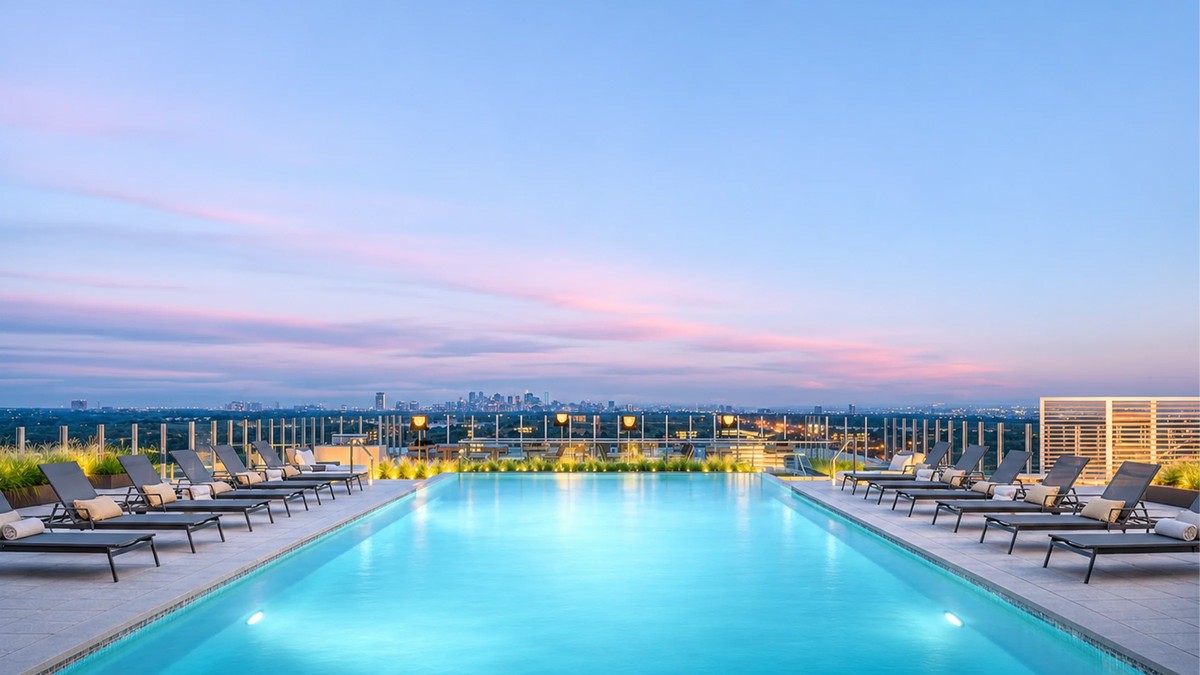
Quick answer: Choose sun loungers when you need flexible, space-efficient seating for individual sunbathing. Choose daybeds when you want a fixed, sociable anchor with shade and presence. Loungers maximize how many guests a deck can hold; daybeds use more space per guest but fill awkward corners, create premium zones and set the tone of the whole deck. Most luxury decks need both.
A pool deck is the most contested square metre on any property. Everyone wants the same thing: sun at the right hour, shade at the wrong one, a view of the water and enough distance from strangers. Demand is back too. Dubai welcomed 6.97 million international overnight visitors between January and August 2026, with August alone bringing about 869,000, the strongest month since February. Winter is when the deck fills.
So the question is not which piece is nicer. It is which piece earns its footprint in each part of the deck.
A sun lounger is a single-person object, long and narrow, that can be lined up, spaced out or moved. A daybed is a room-sized object for two or more, and it stays where you put it. Put either in the wrong place and the whole deck suffers. Loungers dropped into a corner leave dead space around them. A daybed dropped onto a narrow edge becomes an obstruction.
The same maths applies at home, just with fewer people. A private villa deck may only need four loungers and one daybed, but the cost of getting it wrong is the same: a deck that looks busy and feels cramped, or one that looks grand and has nowhere comfortable to lie in the sun.
Retail pool chairs rarely survive commercial use or a Gulf summer. Frames flex, slings sag, cushions bake. That is why specifying true luxury outdoor furniture engineered for the Middle East is the only way to protect a deck investment. The specification habits behind it are set out in how to specify outdoor furniture like a hospitality designer.

The Spatial Breakdown: Outdoor Daybeds vs Sun Loungers: Which Suits Your Pool Deck?
The two pieces solve different problems. This is how they compare on the factors that decide a deck.
| Factor | Sun loungers | Outdoor daybeds |
|---|---|---|
| Typical footprint | Roughly 2.0–2.1 m long and 0.7–0.85 m wide | Roughly 2.0 m square or round, larger with a canopy |
| Guests per piece | One | Two or more |
| Deck area per guest (planning figure) | About 3.5-4 m² including circulation | About 6-7 m² including circulation |
| Movement | Light, often wheeled, sometimes stackable | Fixed in place |
| Shade | Needs a separate parasol | Often has an integrated canopy or roof |
| Upholstery volume | One slim pad | Roughly three to four times a lounger pad |
| Wind behavior | Light frames can shift; parasols need weighting | Canopies catch wind and need anchoring |
| Best zone | Water's edge, long straight runs | Corners, platforms, alcoves, premium areas |
1. Spatial Economics: The Square Footage Reality
The physical reality. A luxury lounger takes up about 2.0 to 2.1 metres by 0.7 to 0.85 metres. That is the object. The space it actually needs is bigger. Give each lounger around 60 to 90 centimetres to the next, and keep a clear walkway of at least 1.2 metres behind the row, and a single lounger claims something close to four square metres of deck.
A daybed is a different animal. A two-metre round or square daybed needs clearance on most sides so guests can climb on and off without stepping over each other. Allow that, and one daybed for two people consumes 12 to 14 square metres.
Run the arithmetic on 200 square metres of usable deck. Loungers alone: around 50 guests. Daybeds alone: about 14 pieces, or 28 guests. That is planning arithmetic, not a rule, and your own product dimensions will move it. The direction never changes. Daybeds cost you head-count.
Two zones need extra care. The safety band around the pool edge must stay clear, so no lounger feet, no daybed corners and no parasol bases. And wet zones near showers and steps stay slippery, which makes them poor positions for anything guests climb onto. Loungers that sit a few centimetres higher are easier to get in and out of, which matters more than it sounds once a deck is full.
The procurement logic. Buyers choose loungers to maximize capacity, and daybeds to raise perceived value. Both are rational. The mistake is choosing one for the whole deck. Overcrowding is among the mistakes hotels make when buying outdoor furniture, and it starts here, with a head-count target that ignores circulation.
The Gulf verdict. Measure the deck, subtract walkways and the safety band around the pool, then plan loungers for the long straight runs and daybeds for the leftover geometry. A corner that cannot hold a tidy lounger row is a daybed position waiting to happen.

2. Behavioural Psychology: Social Hubs vs Individual Retreats
The physical reality. Loungers are solitary by design. They let strangers lie a metre apart and still feel alone. The anthropologist Edward Hall called this personal distance, part of the study of proxemics: the invisible bubble people protect in public. A row of loungers respects that bubble. Each guest owns a strip of territory, a towel and a side table.
Daybeds do the opposite. They pull people together. A couple, a family, three friends with a bottle of something cold. Conversation happens on a daybed in a way it never does across two loungers.
That is why placement decides the mood. Put a daybed in a quiet adult reading zone and the laughter from it carries across the water. Put a row of loungers in the middle of a party area and nobody can hear each other. Each piece has a social signal, and guests read it instantly.
Time of day shifts the balance. Mornings belong to swimmers and sunbathers, who want loungers and quiet. Late afternoons belong to groups, who drift towards daybeds, music and the bar. A deck that offers both lets the same space serve two crowds without a single piece moving. Privacy matters too: a planter or screen beside a daybed makes it feel like a room, and guests will pay for that feeling.
The procurement logic. Buyers who think only in seats miss this. The better question is who uses each zone and how. Families and groups want daybeds. Solo guests and readers want loungers with space either side. Couples like both, at different times of day.
The Gulf verdict. Zone by behaviour first, then by geometry. Keep loungers for calm edges and sunbathing, and give daybeds the sociable corners. A deep, low outdoor daybed works best where noise is welcome.

3. Operational Agility: Stacking, Moving and Shamal Winds
The physical reality. Pool decks change shape constantly. An event tonight, a cleaning crew tomorrow morning, a storm on Friday. Loungers handle that. Most aluminium loungers are light enough for one person to move, many have wheels at the head end, and some stack. Daybeds are monoliths. Once a daybed is placed, it stays.
Wind is the other test. On 29 October 2026 the forecast called for winds of 10 to 25 km/h reaching 50 km/h, fresh to strong at times, with blowing dust. Gusts like that shift light loungers and tip unweighted parasols. A daybed canopy behaves like a sail. The structure, the frame and the fixing all need to be designed for it.
The procurement logic. Ask how much each lounger weighs, whether it has wheels and whether it stacks. For daybeds with canopies, ask how the frame is anchored, what wind speed the canopy is rated for and whether the fabric can be removed or retracted quickly. A canopy that has to be dismantled every time the forecast turns is a staff problem, not a design feature.
Storage is the forgotten line item. If loungers are cleared for an event or a storm, they have to go somewhere. A deck with forty loungers needs a store room or a covered bay that can take them, plus a route to get there that does not cross wet tiles. Plan that space with the architect, not after handover.
Lightness should never mean flimsiness. The frame material decides how long both pieces last, as compared in teak, aluminium, stainless steel and woven fibre.
The Gulf verdict. Loungers win on agility. Daybeds win on permanence. If your deck hosts events or faces open water, plan storage for loungers and anchoring for daybeds before you order either.

4. The Return on Shade: Integrated Canopies vs Parasols
The physical reality. Gulf sun does not soften on schedule. As October 2026 closed, UAE maximum temperatures were still running between 37°C and 43°C, about 4°C above normal in places, with coastal humidity up to 90 per cent. A lounger without shade is unusable for most of the day for most of the year.
Loungers therefore come as a pair of products: the lounger and the parasol. A cantilever parasol can shade two or three loungers from an offset base, which keeps the pole away from the bodies. A centre-pole parasol is simpler and heavier, and works between pairs. Either needs a base, weighting and someone to open and close it. Shade for hospitality is covered in more depth in outdoor umbrellas for hospitality projects.
Daybeds often bring their own shade. A canopy in a tensioned mesh such as Batyline filters light and lets air move; a slatted aluminium roof gives deeper shade. One object, one shade solution, one maintenance routine.
Orientation changes everything. The sun swings low in winter and high in summer, and the water reflects light back up under a parasol. A lounger that sits in perfect shade at noon in July may be in full sun by three in the afternoon in November. Track the sun on site for a day before fixing positions, and choose lighter canopy fabrics where heat build-up underneath is a concern.
The procurement logic. Compare cost-to-shade, not just cost per piece. Count how many guests each shade solution covers, how many parts it adds and how often it must be handled. Sometimes a few large parasols over a lounger zone beat individual daybed canopies. Sometimes one canopy daybed replaces two loungers, two side tables and a parasol.
The Gulf verdict. Plan shade at the same time as seating. For larger shaded areas, a bioclimatic pergola can cover a whole lounge zone with adjustable louvres.

5. Material Science and the Upholstery Burden
The physical reality. Volume is the hidden cost of a daybed. A lounger pad might be about 190 by 65 centimetres and 8 centimetres thick. A double daybed mattress can be 200 by 140 centimetres and 15 centimetres thick. That is roughly three to four times the foam and fabric, and three to four times the surface for dust, sunscreen and spills to land on.
Two materials make that volume manageable. Reticulated foam, often called quick-dry foam, has an open-cell structure that lets water drain straight through instead of soaking in. Solution-dyed acrylic carries its colour through the fibre, so it resists fading in strong sun. Together they make a mattress that dries after a rinse instead of staying damp for days, which matters when coastal humidity sits high. The long-term picture is set out in how long luxury outdoor furniture should last.
The procurement logic. Ask for the foam type, the fabric construction and whether covers zip off. A daybed mattress with a fixed cover is a mattress you cannot properly clean.
Loungers carry a lighter burden, but slings deserve a mention. A tensioned mesh sling has no foam at all, dries in minutes and sheds dust with a brush, which makes it the lowest-maintenance seat on any deck. Many luxury loungers combine a mesh sling with a thin removable pad, so guests get comfort and staff get a surface that recovers quickly between uses.
The cleaning protocol. Vacuum dust daily in busy periods. Spot-clean sunscreen marks the same day, because oils set in heat. Unzip and wash covers on a rota. Stand mattresses on edge to dry fully. Store soft goods before storms, and fit breathable protective covers during long breaks. The dust side of this routine is covered in protecting outdoor furniture from sand and dust, and resort routines in how luxury resorts protect their outdoor furniture.
The Gulf verdict. Budget staff time for daybed upholstery from the start. Replacement mattress pads should come from the same fabric as the originals so colours match. The aftercare guidance should agree with the routine above.

6. Hospitality Revenue: The Daybed and Cabana Model
The physical reality. On a resort deck, a lounger is a basic guest right. A daybed is a product. Many Dubai beach clubs and resort pools sell daybeds and cabanas on a minimum-spend basis, which turns furniture into a food and beverage counter.
That model only works when demand is there, and it is building. Dubai's hotel occupancy reached 66 per cent in August 2026, up from 36 per cent in March, with room inventory approaching 149,000. Busier decks make premium zones easier to sell.
Placement creates the tiers. Standard loungers sit along the main pool. A row of premium loungers with larger parasols sits closer to the bar or the view. Daybeds and cabanas take the corners, the platforms and the best sightlines. Each tier looks and feels different, which is what lets it carry a different price.
Private decks use the same idea in a quieter way. A villa might keep two loungers by the water for morning swims and a single daybed under shade for evenings with family or guests. The hierarchy is about how the space is used through the day rather than about price.
Service shapes the layout as much as seating does. A minimum-spend daybed needs a waiter route that does not cut through lounger rows, a side table large enough for food, and ideally shade and privacy on at least one side. If guests have to wave across the pool to order, the revenue model weakens. Plan the service path first and place the premium pieces along it.
The procurement logic. Revenue pieces need to stay immaculate, because guests are paying for the look. That raises the specification bar on frames, fabrics and shade. The wider procurement process for hotels is covered in luxury outdoor furniture procurement for hotels and resorts, and the scope of the work in what outdoor FF&E procurement involves.
The Gulf verdict. If the deck is commercial, plan daybeds and cabana structures as revenue zones, not as decoration. Teams without an in-house specifier can use outdoor FF&E procurement support.
7. The Hybrid Deck: Zoning Your Pool Area
The best answer is rarely one or the other. It is both, in the right places. This is how I draw a zoning map for any deck, private or commercial.
- Measure and mark the fixed lines. Draw the pool edge, the safety band around it, doors, steps, bars and the main walkways. Nothing goes on these.
- Mark the sun. Note where shade falls in the morning, at noon and in late afternoon. Prime sun positions are lounger positions.
- Place loungers on the long runs. The water's edge and straight sections suit rows. Keep spacing consistent.
- Give the leftover geometry to daybeds. Corners, raised platforms, alcoves and the ends of rows suit daybeds.
- Layer the shade. Parasols over lounger runs, canopies or pergolas over daybeds.
- Check the flow. Walk the route from the entrance to the bar to the water. If you have to turn sideways anywhere, remove a piece.
Revisit the map each season. In the cooler months, guests want more sun and fewer canopies, so some daybeds can lose their shade and loungers can move closer together. In summer, shade wins and spacing should open up. A layout that flexes with the season keeps the deck full all year.
Shallow ledges and sun shelves deserve their own thought. Loungers designed for water use can sit on a shelf; standard daybeds should not. On a private villa deck, the same logic applies at smaller scale, as described in outdoor furniture for a luxury villa. Small touches finish the zones: side tables beside every lounger pair, and a rug to define a daybed lounge.
The Gulf verdict. Loungers for capacity, daybeds for character, and a plan that gives each one the space it needs. A zoning map drawn before ordering saves more than any discount. For pieces to plan around, the sun lounger collection is a useful starting point.

FAQs
Can I put an outdoor daybed on a shallow Baja shelf in my pool?
Not a standard daybed. Upholstery and frames are not built to sit in water. Use loungers or seating designed for in-water use, and keep daybeds on the dry deck nearby.
Are sun loungers or daybeds better for small luxury villa backyards?
Usually two good loungers and one parasol. A daybed can work in a small garden if it fills a corner and leaves a clear path around the pool. Measure before you choose.
How much space should I leave between sun loungers on a commercial deck?
Around 60 to 90 centimetres between loungers, with at least 1.2 metres of clear walkway behind each row. Leave more space in premium zones.
Do daybed canopies withstand high winds in the UAE?
Well-engineered canopies do, if the frame is anchored and the fabric can be retracted or removed. Ask for the wind rating and take canopies down before strong winds.
What is the best material for sun loungers in direct saltwater splash zones?
Powder-coated aluminium frames with 316L stainless steel fixings, plus quick-dry foam and solution-dyed acrylic fabric. Rinse off salt regularly.
Are stacking sun loungers considered luxury FF&E?
They can be. Stacking is a practical feature, not a mark of low quality. Judge the frame, finish, fabric and comfort, not whether it stacks.
How do I protect large daybed cushions from Dubai dust storms?
Store cushions before the storm or fit breathable covers. Afterwards, vacuum dry dust first, then spot-clean. Never rub dry dust into the fabric.


